Q: What drew you to medicine and ultimately to ophthalmology?
A: I started out deeply interested in physics and engineering. But during college, I had a medical emergency and associated bills which prompted me to nearly drop out. My surgeon stepped in and alleviated the costs so I could stay in school.
That experience fundamentally changed my trajectory, sparking a commitment to the humanitarian side of medicine.
It also took time to figure out how to combine engineering with medicine. I found that ophthalmology was the perfect intersection. There’s a strong foundation in optics and technology, and it’s one of the fastest fields for translating innovation into patient care. Restoring vision can have an immediate, life-changing impact.
Q: How does your background in engineering shape your research today?
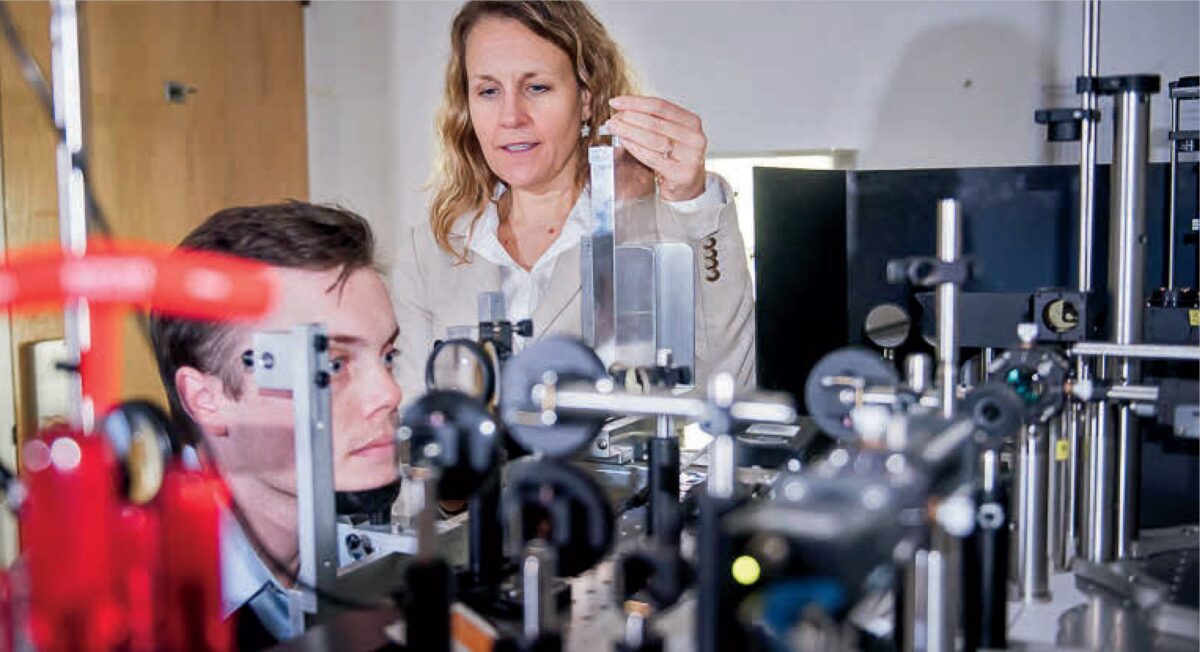
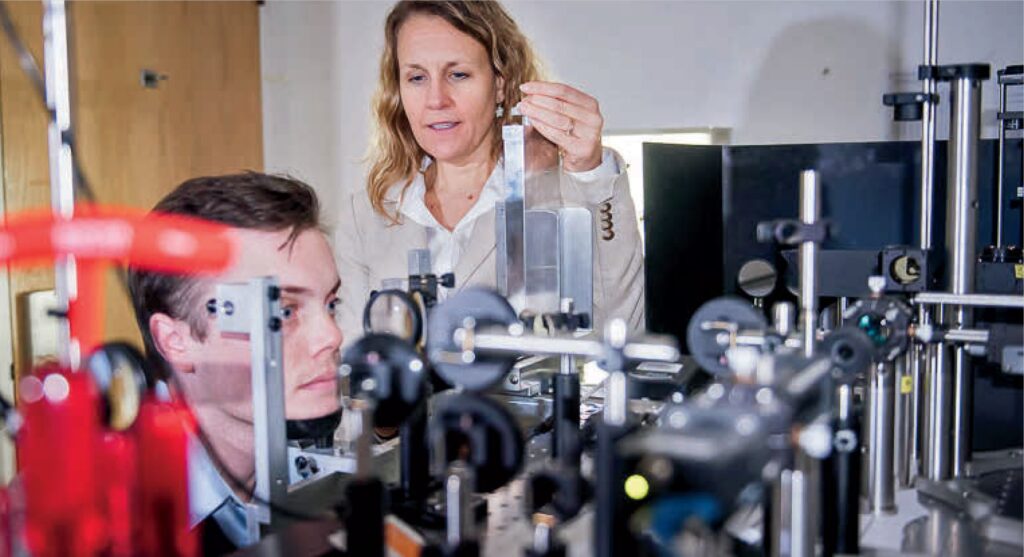
A: My lab focuses on developing new optical imaging and laser technologies to better understand and treat eye disease. I started by building advanced microscopes during my PhD, and that work has evolved into a full-scale optics lab where we design both imaging systems and therapeutic platforms.
We’re not just observing disease, we’re creating entirely new ways to visualize and intervene, often at the cellular level, in living systems. That combination of physics, engineering and medicine is what drives our work.
Q: Can you describe one of your most promising innovations?
A: One major focus is glaucoma, a leading cause of irreversible blindness. All currently approved treatments aim to lower pressure inside the eye, but they can be invasive or ineffective for some patients.
We’ve developed a technology that allows us to see deep in the eye, even through non-transparent tissues, at cellular resolution. For the first time, we can directly and non-invasively visualize and measure how fluid flows through the eye’s drainage system.
What’s especially exciting is that we can then use this platform to deliver targeted laser therapy without incisions or invasive surgery. It’s essentially non-invasive, image-guided laser surgery. If successful in clinical trials, this could fundamentally change how we treat glaucoma.
Q: How do you move technologies like this from the lab to patients?
A: We pursue both academic and translational pathways. On one side, we conduct NIH-funded research and publish discoveries. On the other, we patent our technologies and launch spinout companies to bring them into clinical use.
The goal is always the same: to move innovations as quickly and safely as possible from the lab bench to patient care.
Q: Your work also contributed to a discovery about retinal neurons and blood vessels. What was significant about that?
A: That discovery came from combining advanced imaging with biological expertise. Our tools allow us to observe the living eye in 3D over time, capturing interactions between neurons and blood vessels with unprecedented detail.
In collaboration with Xin Duan, PhD, we used this capability to identify a previously unknown mechanism of neurovascular development. It’s a great example of how new tools enable collaboration and can unlock entirely new biology.
Q: There’s growing interest in the idea of the eye as a “window to the body.” What does that mean?
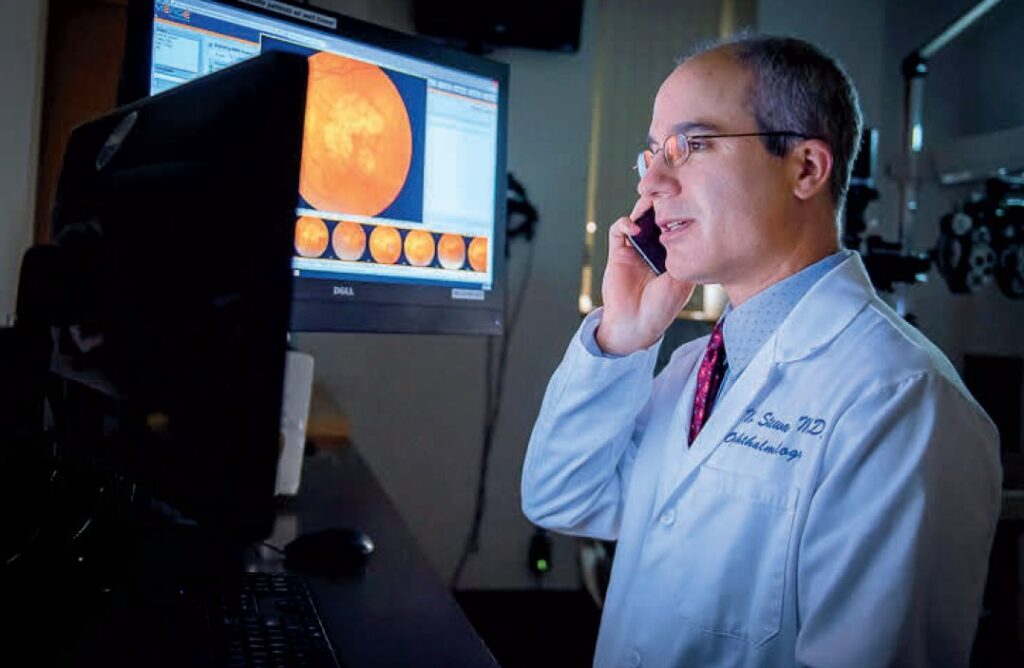
A: The eye is unique because it’s the only place in the body where we can directly visualize blood vessels and neural tissue non-invasively and with microscopic resolution. Historically, clinicians have used this qualitatively, for example, noticing signs of high blood pressure or diabetes.
Now, with advanced imaging and AI, we can quantify these signals. That means we can potentially detect or predict systemic diseases—like heart disease or stroke—just from an image of the eye.
This is part of a broader field called “oculomics,” where we use the eye as a platform for understanding whole-body health.
Q: What excites you most about the future of this work?
A: The combination of accessibility and precision. The eye is one of the best places in the body to both study disease and test new therapies. It’s often where major medical breakthroughs happen first including gene therapy, stem cell therapy, targeted biologics, and artificial intelligence.
Now, with advances in imaging, laser technology, and computation, we’re entering a phase where we can not only see disease in unprecedented detail, but also intervene with incredible precision.
Q: Why is UCSF and the Bay Area an ideal place for this research?
A: UCSF provides an outstanding clinical and research environment, with strong institutional support and a top-tier ophthalmology program.
Equally important is the Bay Area ecosystem. The culture of innovation, entrepreneurship, and collaboration makes it possible to rapidly translate ideas into real-world solutions. That combination accelerates progress in a way that’s hard to replicate elsewhere.
Q: What impact do you hope your work will have?
A: If I can help cure even one or two forms of blindness in my career, that would be incredibly meaningful. And right now, it feels like that’s within reach.