Research to the Rescue (Action against COVID-19)

Close-up of a person's eyes with statistical analysis.
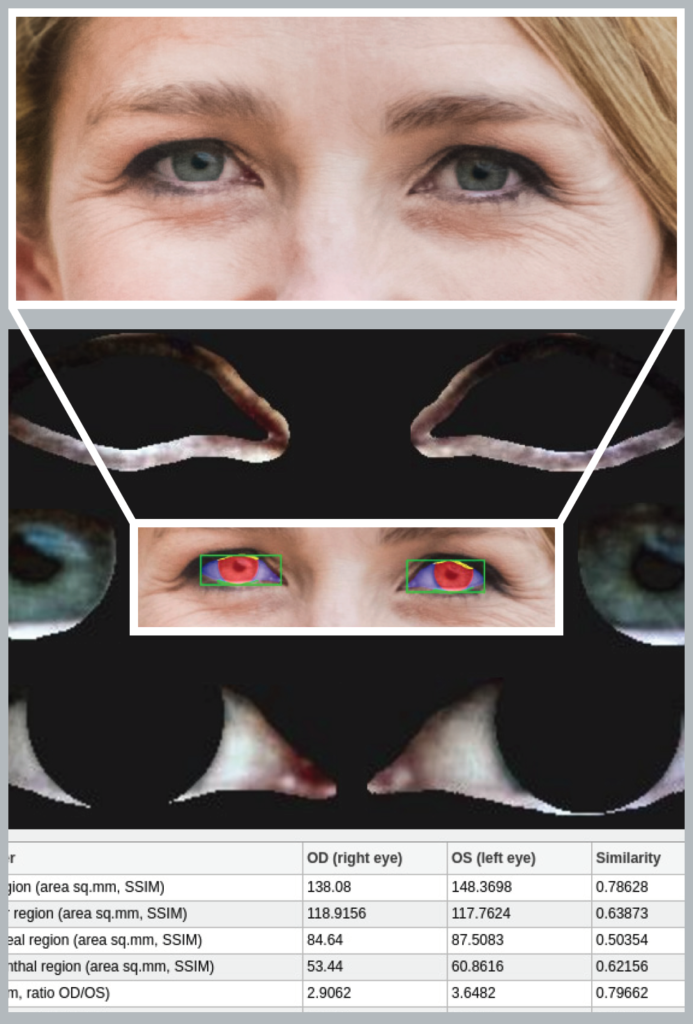
A novel artificial intelligence tool automatically generated measurements for eye characteristics from a digital image of Dr. Seanna Grob. The tool has the potential to diagnose external eye disorders from photos taken at home during the pandemic.

At press time, UCSF vision scientists had already launched 18 research projects to address aspects of the COVID-19 pandemic. Here are a few highlights.


Forecasting Viral Spread in California

Travis Porco, PhD, MPH; Lee Worden, PhD; Seth Blumberg, MD; and Rae Wannier, BS; of the Proctor Foundation are analyzing mathematical models to guide public health policy, in coordination with the San Francisco Department of Health. The team’s analysis focuses on real-time assessment of current control measures, as well as analysis of contact investigation, mask usage, and social distancing.


Using Artificial Intelligence and Selfies to Diagnose Eye Diseases

Luca Della Santina, PhD, and Michael Deiner, PhD, lead a team of clinicians and computer scientists to develop “deep learning” methods that can identify conditions that affect the surface of the eye (external disorders) from selfie images taken by patients (or their families or caregivers) at home. This tool has strong potential to support telemedicine for vision care during and after the pandemic. Collaborators include Seanna Grob, MD; Julius Oatts, MD; Gerami Seitzman, MD; Tom Lietman, MD; and M. Reza Vagefi, MD.


Home Testing for Glaucoma Patients

Yvonne Ou, MD, and Michael Deiner, PhD, are studying whether a novel mobile visual field test for glaucoma patients can provide an effective at-home alternative to conventional in-clinic testing during the pandemic. Co-developed with Vivid Vision, Inc., the test uses inexpensive virtual reality headsets and oculokinetic perimetry methods pioneered by Bertil Damato, MD, PhD, FRCOphth. Dr. Ou can quickly evaluate the results of tests that her patients perform in their homes.
 

Two healthcare workers in protective gear at a UCSF Health tent.
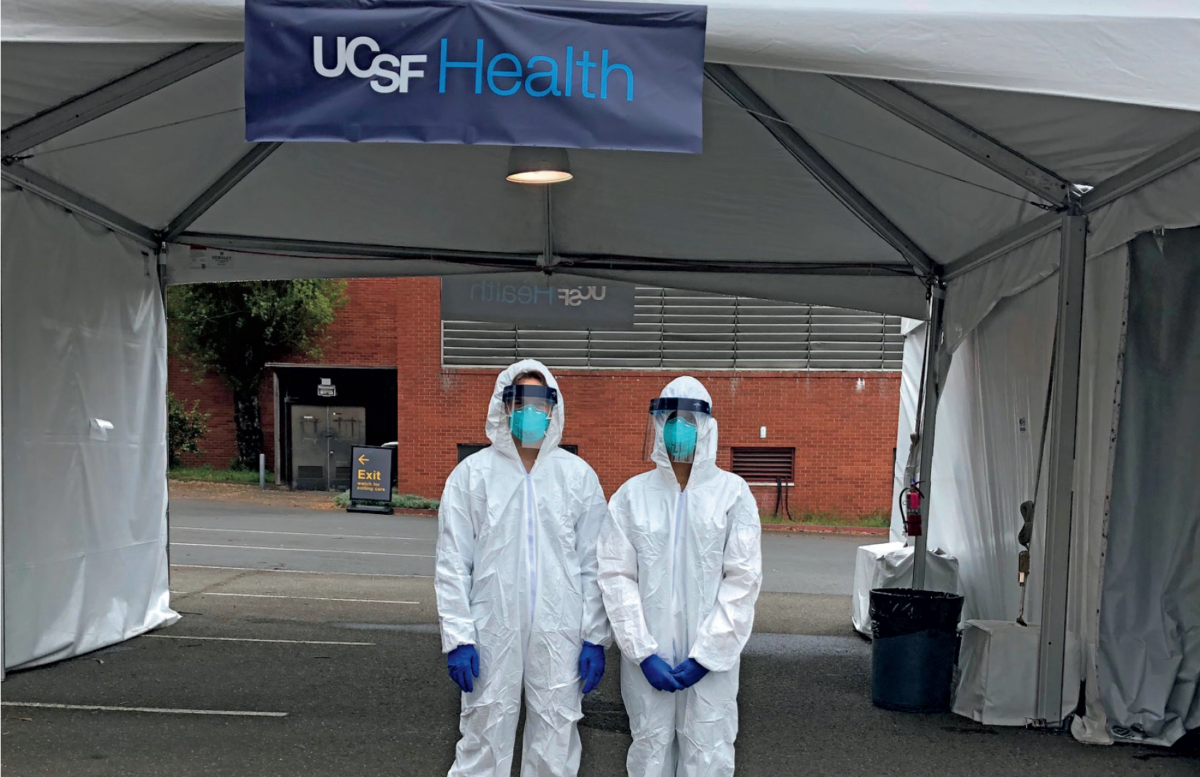
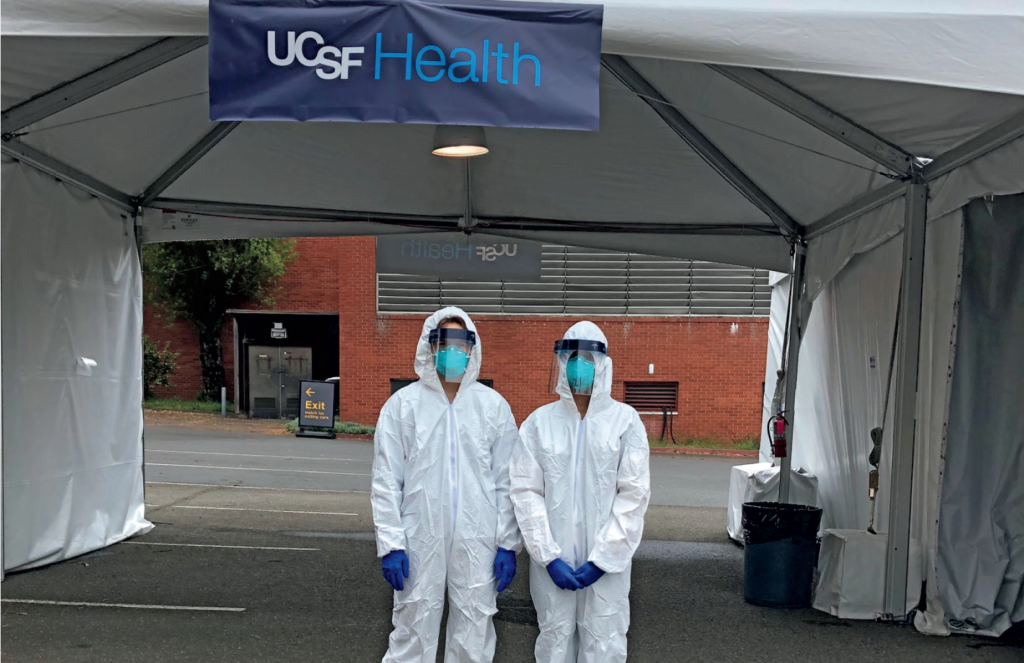
At a COVID-19 screening tent, a Proctor fellow and a nurse study virus aerosolization caused by speech.

Pinpointing Short-Distance Viral Spread

Julie Schallhorn, MD, and Gerami Seitzman, MD, lead two investigations to determine the presence and prevalence of aerosolized SARS-CoV2 viral particles emitted when patients speak (or sing!). One focuses on people at a testing site and the other on patients convalescing at home. The team also includes Thuy Doan, MD, PhD, who performs the genetic diagnostic testing, and Miel Sundararajan, MD. Findings will inform future safety guidelines.


UCSF East Bay Vision Clinic

Providing vision care in comprehensive ophthalmology, glaucoma, retina, oculoplastics, and optometry. Call 415.353.2800 to discuss moving your vision care.

Research support is provided by the National Institutes of Health, Research to Prevent Blindness, and That Man May See.
ACTION Against COVID-19

Orange badge with a virus symbol and text 'Responding to COVID-19'.

Clinical Study of Azithromycin

Premier research teams worldwide are racing to halt the devastation of this novel coronavirus. The Francis I. Proctor Foundation for Research in Ophthalmology quickly joined the fight, using its 20 years of experience with the antibiotic azithromycin to search for solutions.

Two decades ago, That Man May See helped to launch the Proctor Foundation’s research to eliminate the blinding disease trachoma in Ethiopia. The seed-funded pilot study examined the impact of azithromycin on infants and young children. Findings proved that the antibiotic drastically reduced prevalence of the eye disease and saved children’s lives.


Leaping into Action

Now, Catie Oldenburg, ScD, MPH, and Thuy Doan, MD, PhD, lead a clinical trial for COVID-19. They have leveraged Proctor Foundation’s deep azithromycin expertise to swiftly initiate a well-designed, nationwide, randomized clinical trial, with support from the Bill & Melinda Gates Foundation. Planning for such rigorous studies often takes months and even years, but the team is already enrolling patients, following a markedly compressed planning period.

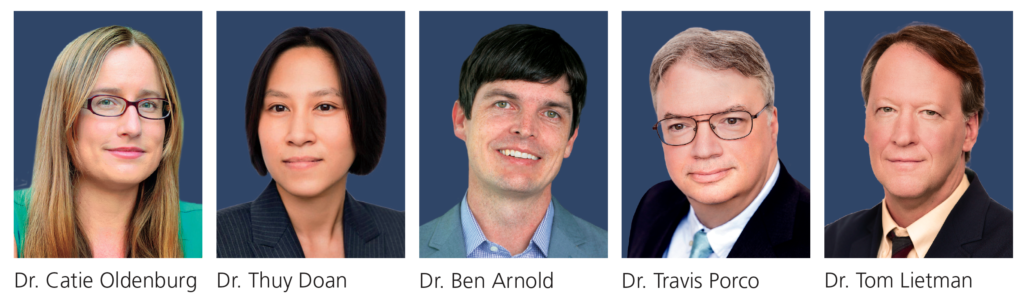
The clinical trial is called Azithromycin for COVID-19 Treatment in Outpatients Nationwide (ACTION). The research team, which also includes Ben Arnold, PhD; Travis Porco, PhD; and Tom Lietman, MD; hopes to recruit at least 2,300 patients by the end of the year.

The trial will help researchers understand the potential effect of a single dose of the antibiotic in halting progression of COVID-19 in patients who are not hospitalized. Azithromycin is an antibiotic used to treat many common bacterial infections, and it may have antiviral and anti-inflammatory properties.

The Proctor team collaborates with the Stanford Clinical Virology Lab to recruit newly diagnosed COVID-19 patients. This lab has been performing a high volume of California tests for the virus, known as SARS-CoV-2. COVID-19 patients nationwide are encouraged to participate, and more virology labs will be recruited as well.


Inside the Trial

Each participating patient will be sent a single dose of the azithromycin or a look-alike placebo. Because the study is conducted completely via mail and email, patients with proof of a positive SARS-CoV-2 test can enroll from anywhere in the United States within seven days of their positive test result. Participants will then complete five short online questionnaires over the subsequent three weeks.  In addition, Dr. Doan and her lab team will analyze biosamples taken at home by interested participants. Their analysis will provide insight into the precise effects of the azithromycin.


Changing Science, Changing World

In the face of this pandemic, the Proctor team is experiencing synergy like never before.

“There’s a level of cooperation across disciplines that was unusual before,” says Dr. Oldenburg. “I feel that the way researchers are working together during the pandemic is going to change how we do science forever.”

Evidence generated by the ACTION trial will serve as a blueprint for future trials. “We don’t think this is the last coronavirus epidemic that we’re going to see,” says Dr. Oldenburg. “What we learn now will allow us to jumpstart effective research practices during future epidemics.”

Dr. Oldenburg stresses the importance of patients stepping forward to participate in gold-standard clinical trials like this one. “To understand and properly evaluate drug treatments,” she says, “the best thing we can do is to conduct and volunteer to take part in randomized controlled trials.”

Five headshots of medical professionals on a blue background.


Join the Trial

If you or someone you know tests positive for COVID-19, please consider enrolling in the ACTION study within three days of diagnosis. Learn more: Website: proctor.ucsf.edu/action-trial
Email: Actiontrial@ucsf.edu
Phone: 415.326.3761